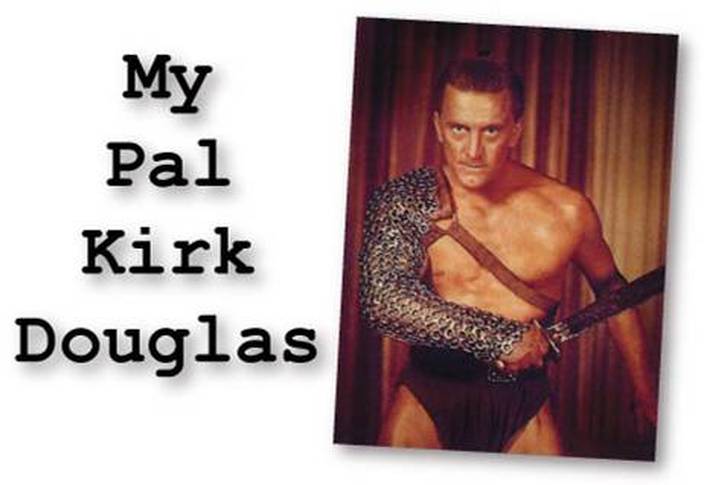
Kirk Douglas was not at all amused.
For the second time, the 91-year-old screen legend had told me he was planning to return to the stage in a one-man show, and for the second time, I told him he should revisit his role as Randle P. McMurphy in One Flew Over the Cuckoo’s Nest (which he had played on Broadway back in 1964) -- this time with an all over-80 cast.
It was the fall of 2008, and I had come to Douglas' Beverly Hills home to interview him for an article I was writing for The Hollywood Reporter about the beginnings of runaway production in the 1950s. I had been there a half hour. I had the quotes I needed. Yet there I sat, repeating the same joke.
I could see it in his eyes. Douglas must be thinking, "Who the hell does he think he is?! This punk, this pisher, wasting my time! " It was as if he was hissing the words through clenched teeth, as over the top as Frank Gorshin's famous impression of the actor. He was Spartacus, dammit! He'd dined with presidents and banged Joan Crawford!
For the second time, the 91-year-old screen legend had told me he was planning to return to the stage in a one-man show, and for the second time, I told him he should revisit his role as Randle P. McMurphy in One Flew Over the Cuckoo’s Nest (which he had played on Broadway back in 1964) -- this time with an all over-80 cast.
It was the fall of 2008, and I had come to Douglas' Beverly Hills home to interview him for an article I was writing for The Hollywood Reporter about the beginnings of runaway production in the 1950s. I had been there a half hour. I had the quotes I needed. Yet there I sat, repeating the same joke.
I could see it in his eyes. Douglas must be thinking, "Who the hell does he think he is?! This punk, this pisher, wasting my time! " It was as if he was hissing the words through clenched teeth, as over the top as Frank Gorshin's famous impression of the actor. He was Spartacus, dammit! He'd dined with presidents and banged Joan Crawford!
The way I remembered it, anyway. But listening to the recording of my visit more than two years later, I discover that my Cuckoo's Nest crack got laughs from the two relatively young female publicists in the room and, regardless of what Douglas might've thought of the joke, he played along like the old pro he was.
"That would be a good show to do, because it's one set," said Douglas of my proposed revival. "I'm going to do it. You gave me a good idea."
If my memories of the day are darker than they deserve to be, it's due to the lingering feeling that, transfixed by the allure of fame, I had overstayed my welcome.
I had a similar feeling about Douglas as I watched him present the Best Supporting Actress Oscar on “The 83rd Academy Awards” telecast last month. The next morning, publications from around the globe declared that the 94-year-old actor had stolen the show when he went wildly off-script, flirting with actresses a third his age, teasing Hugh Jackman and performing a will-he-or-won’t he routine with the envelope. I too was charmed by Douglas, but after the third unsuccessful attempt to ease him off the stage, I was half-expecting him to break out into "And I Am Telling You I'm Not Going" from Dreamgirls.
On one level, it was inspiring that a hunched and wrinkled nonagenarian not only had the wherewithal to walk across the expansive stage of the Kodak Theater and perform under blinding lights, but the cojones and the charisma to command the rapt attention of tens of millions of viewers worldwide armed with nothing but a cane and a handful of seemingly-improvised wisecracks. But if a celebrity between the ages of 8 and 80 had been similarly hogging the spotlight during someone else’s big awards moment, pundits would be making unflattering comparisons to Kanye West stealing the microphone from Taylor Swift at the MTV Video Music Awards in 2009. Of course, Douglas' manner was relaxed and engaging, not aggressive and confrontational like West’s, and, besides, it’s a universal truth that otherwise inappropriate actions are somehow charming if performed by infants or the aged ("Did you see him try to pinch the waitress' butt? How cute is that?").
What was most unsettling to me was the idea that after all the years of fame and acclaim, Douglas still needs it -- and us -- so badly. He still has something to prove, whether the audience is millions of TV viewers or a single reporter, as I found out when I rang the doorbell of the actor's home just south of Sunset Blvd. two and a half years earlier.
Check back for My Pal Kirk Douglas, Pt. 2.
"That would be a good show to do, because it's one set," said Douglas of my proposed revival. "I'm going to do it. You gave me a good idea."
If my memories of the day are darker than they deserve to be, it's due to the lingering feeling that, transfixed by the allure of fame, I had overstayed my welcome.
I had a similar feeling about Douglas as I watched him present the Best Supporting Actress Oscar on “The 83rd Academy Awards” telecast last month. The next morning, publications from around the globe declared that the 94-year-old actor had stolen the show when he went wildly off-script, flirting with actresses a third his age, teasing Hugh Jackman and performing a will-he-or-won’t he routine with the envelope. I too was charmed by Douglas, but after the third unsuccessful attempt to ease him off the stage, I was half-expecting him to break out into "And I Am Telling You I'm Not Going" from Dreamgirls.
On one level, it was inspiring that a hunched and wrinkled nonagenarian not only had the wherewithal to walk across the expansive stage of the Kodak Theater and perform under blinding lights, but the cojones and the charisma to command the rapt attention of tens of millions of viewers worldwide armed with nothing but a cane and a handful of seemingly-improvised wisecracks. But if a celebrity between the ages of 8 and 80 had been similarly hogging the spotlight during someone else’s big awards moment, pundits would be making unflattering comparisons to Kanye West stealing the microphone from Taylor Swift at the MTV Video Music Awards in 2009. Of course, Douglas' manner was relaxed and engaging, not aggressive and confrontational like West’s, and, besides, it’s a universal truth that otherwise inappropriate actions are somehow charming if performed by infants or the aged ("Did you see him try to pinch the waitress' butt? How cute is that?").
What was most unsettling to me was the idea that after all the years of fame and acclaim, Douglas still needs it -- and us -- so badly. He still has something to prove, whether the audience is millions of TV viewers or a single reporter, as I found out when I rang the doorbell of the actor's home just south of Sunset Blvd. two and a half years earlier.
Check back for My Pal Kirk Douglas, Pt. 2.

 RSS Feed
