The History
Kirk Douglas
knows all about "runaway production" to foreign locales. Sitting on a
striped couch in
the living room of his Beverly Hills home, surrounded by paintings by
Balthus, Vuillard and other modernist masters, the screen legend can
still feel the sting of betrayal 50 years later.
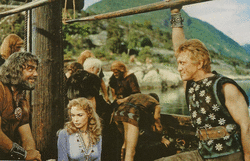
After an arduous day of shooting boat-rowing scenes for "The Vikings" (1958) in Norway, Douglas decided to reward the locals who served as oarsmen with a party featuring a burlesque show, starring himself and castmates Tony Curtis and Janet Leigh.
The extras ate the food, drank the booze, laughed, applauded and yelled for more.
"And the next day, they went on strike," says Douglas, who made the film through his production company, Bryna Prods., and starred in the production. He's laughing now, but he wasn't then. "I was very mad. I called my troops together and I said, 'Tell me. What are the shots we still have to do?' I figured out we could do them (on a soundstage) in Munich. So I said, 'Pack up. We're going,' and I left."
Click here to read the entire article from The Hollywood Reporter.
After an arduous day of shooting boat-rowing scenes for "The Vikings" (1958) in Norway, Douglas decided to reward the locals who served as oarsmen with a party featuring a burlesque show, starring himself and castmates Tony Curtis and Janet Leigh.
The extras ate the food, drank the booze, laughed, applauded and yelled for more.
"And the next day, they went on strike," says Douglas, who made the film through his production company, Bryna Prods., and starred in the production. He's laughing now, but he wasn't then. "I was very mad. I called my troops together and I said, 'Tell me. What are the shots we still have to do?' I figured out we could do them (on a soundstage) in Munich. So I said, 'Pack up. We're going,' and I left."
Click here to read the entire article from The Hollywood Reporter.
The Hype
It’s a universal scenario that’s at
least as old as
“Leave It to Beaver”: A child asks mom and dad if he or she can do the
cutting-edge thing that the kid up block is doing, and the parents
reply,
“If the kid up the block jumped off a bridge, would you jump off a
bridge, too?” That used to be the attitude of state legislatures when
people pleaded with them to establish tax credits or rebates to
encourage
film and TV production. Federal crop subsidies might be OK, but
production incentives were looked upon as handouts, corporate welfare,
or worse, creeping socialism. Just because Canada was doing it, it
didn’t mean we were going to do it, too.
But times have changed. It’s like coming home from college to find mom has pierced her navel, and both dad and your high school science teacher have gotten tribal tattoos.
Click here to read the entire article from The Hollywood Reporter.
But times have changed. It’s like coming home from college to find mom has pierced her navel, and both dad and your high school science teacher have gotten tribal tattoos.
Click here to read the entire article from The Hollywood Reporter.
When Georgia-based
animal wrangler Renee
DeRossett heard that Gov. Sonny Perdue was signing a law upping her
state’s entertainment production tax credit to as much as 30%, she could
barely contain her joy.
“Oh, my land!” she exclaimed. “That is the best news I’ve heard in a long time.”
It may seem like a silly thing to get so excited about, but for people like DeRossett, incentives such as these can mean the difference between buying a bigger, more expensive home and facing foreclosure on a smaller, cheaper one.
Click here to read the entire article from The Hollywood Reporter.
Click here to read my latest article about Georgia production in Variety.
“Oh, my land!” she exclaimed. “That is the best news I’ve heard in a long time.”
It may seem like a silly thing to get so excited about, but for people like DeRossett, incentives such as these can mean the difference between buying a bigger, more expensive home and facing foreclosure on a smaller, cheaper one.
Click here to read the entire article from The Hollywood Reporter.
Click here to read my latest article about Georgia production in Variety.
The Bottom Line
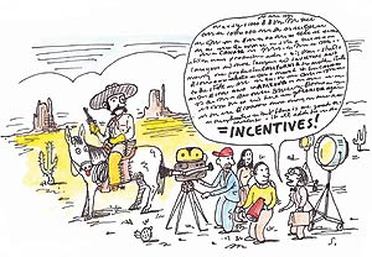
The vast majority of industryites -- from left-leaning opponents of corporate welfare to right-leaning anti-government types -- seem to agree on one thing: Domestic production incentives -- which are offered in 40 U.S. jurisdictions, including Puerto Rico and the District of Columbia -- are good news for them and for their local economies, and it's not hard to see why. On the surface, attractive incentives lure Hollywood productions that create jobs and spend money in the communities.
But the net benefit of incentive programs is complicated, controversial and frequently misunderstood.
Click here to read the full article from Variety.
But the net benefit of incentive programs is complicated, controversial and frequently misunderstood.
Click here to read the full article from Variety.
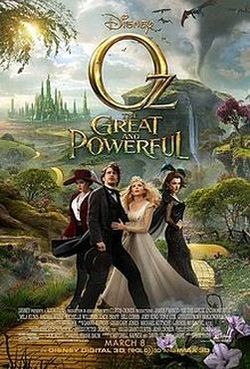
In this era of ever-increasing partisan rancor, there’s one thing that can still get people to reach across the political divide, hold hands and sing “Kumbaya" – the opportunity to grab as much public money as the law and starry-eyed government officials will allow. A case in point: Michigan Motion Picture Studios in Pontiac, Michigan, where Disney shot “Oz the Great and Powerful,” lured by nearly $40 million in tax credits from the state.
Opened in April 2011, the $80-million complex was financed with just $20 million in private equity. The rest of the money came from a variety of federal and state sources, including $18 million in bonds guaranteed by the State of Michigan Retirement Systems (SMRS) pension fund.
The idea for the studio was first floated by Linden Nelson, a local Pontiac entrepreneur who patented the removable key chain for valet parking in the early ‘90s. He brought the idea to his old friend, William Morris Endeavor co-CEO Ari Emanuel, the inspiration for the Ari character on HBO’s “Entourage” and the brother of Rahm Emanuel, former chief of staff to President Obama and current Chicago mayor. The leadership of the investment group was rounded out by A. Alfred Taubman, a billionaire shopping mall developer who went to prison for price fixing in 2002, and John Rakolta, CEO of construction giant Walbridge, finance chair for Mitt Romney’s 2008 presidential campaign and husband of onetime anti-obscenity activist Terry Rakolta, who had 15 minutes of fame when she called for a boycott of Fox’s “Married…with Children" back in 1989.
A month after “Oz” wrapped in early 2012, the studio had gone from employing 3,000 people to just 15 or 20. It subsequently defaulted on bond payments of $420,000 and then $630,000, leaving the pension fund to cover them.
In this article I wrote for Variety, I explain how and why this and other government-funded show biz boondoggles are an increasingly common occurrence. (My voice got flattened out a bit in the editorial back and forth, but it's packed with good info.)
Opened in April 2011, the $80-million complex was financed with just $20 million in private equity. The rest of the money came from a variety of federal and state sources, including $18 million in bonds guaranteed by the State of Michigan Retirement Systems (SMRS) pension fund.
The idea for the studio was first floated by Linden Nelson, a local Pontiac entrepreneur who patented the removable key chain for valet parking in the early ‘90s. He brought the idea to his old friend, William Morris Endeavor co-CEO Ari Emanuel, the inspiration for the Ari character on HBO’s “Entourage” and the brother of Rahm Emanuel, former chief of staff to President Obama and current Chicago mayor. The leadership of the investment group was rounded out by A. Alfred Taubman, a billionaire shopping mall developer who went to prison for price fixing in 2002, and John Rakolta, CEO of construction giant Walbridge, finance chair for Mitt Romney’s 2008 presidential campaign and husband of onetime anti-obscenity activist Terry Rakolta, who had 15 minutes of fame when she called for a boycott of Fox’s “Married…with Children" back in 1989.
A month after “Oz” wrapped in early 2012, the studio had gone from employing 3,000 people to just 15 or 20. It subsequently defaulted on bond payments of $420,000 and then $630,000, leaving the pension fund to cover them.
In this article I wrote for Variety, I explain how and why this and other government-funded show biz boondoggles are an increasingly common occurrence. (My voice got flattened out a bit in the editorial back and forth, but it's packed with good info.)
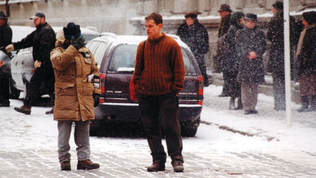
From Lucasfilm's "The Young Indiana Jones Chronicles," immediately post-Velvet Revolution in 1990, to the upcoming Amazon/Sky Channel historical drama "Britannia," I examine the evolving state of film and TV production in the Czech Republic in Variety.
When Oliver Stone made "The Doors" (1990), he painstakingly restored large portions of the Sunset Strip between Larrabee St. and Hilldale Ave. to their mid '60s glory. I know because I was able to observe it from my office overlooking what is now the Viper Room.
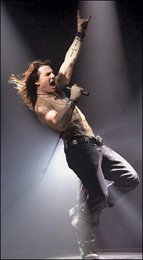
I'm embarrassed to say that I was also around for hair metal's heyday in the late '80s, when on Saturday nights the Strip was so crowded with wannabe rock gods and Spandex-ed vixens it looked like someone had turned the Midwest upside down and shook loose every Aqua Netted idiot on to the streets of West Hollywood. So maybe I should be relieved that director Adam Shankman has gone to the other end of the country to Miami, Florida, recreate that milieu for his Warner Bros. big screen adaptation of the musical "Rock of Ages," starring Tom Cruise.
I'm embarrassed to say that I was also around for hair metal's heyday in the late '80s, when on Saturday nights the Strip was so crowded with wannabe rock gods and Spandex-ed vixens it looked like someone had turned the Midwest upside down and shook loose every Aqua Netted idiot on to the streets of West Hollywood. So maybe I should be relieved that director Adam Shankman has gone to the other end of the country to Miami, Florida, recreate that milieu for his Warner Bros. big screen adaptation of the musical "Rock of Ages," starring Tom Cruise.
|
If you want to know why "Rock of Ages" and so many other productions are now choosing to shoot in the Sunshine State, read my article in Variety.
Here are some photos of the "Rock of Ages" set in Miami, along with a covert video tour. |
|
For years, the closest the city of Holland, Mich., got to big time show
business was its annual Tulip Time Festival. That all that changed in
April 2008 when the state enacted a film and TV incentive package
highlighted by a refundable tax credit of up to 42% of in-state
production spend and a 25% tax credit for film and digital media
infrastructure investments.
Shortly thereafter, TicTock Studios set up shop in a downtrodden neighborhood on the south side of town and started churning out low-budget films, first "Tug," starring Haylie Duff, then "Milk" screenwriter Dustin Lance Black's directorial debut "What's Wrong With Virginia," starring Jennifer Connelly and Ed Harris. Today, it occupies 10 structures within a two-block radius, including an old office building that has been turned into production and casting offices and a rundown transmission shop that has been cleaned up, painted bright red, and transformed into prop shop ...
It's an inspiring scene, one that the other 40 U.S. states currently offering significant production incentives would like to see playing out in their cities and municipalities. A recent survey by the Associated Press estimates that states gave $1.8 billion in tax breaks and other incentives to the entertainment industry from 2006-08, as they've progressively one-upped one another with more generous tax credits.
But with Michigan facing a $2.7 billion budget shortfall and other incentive states in similar dire economic straits, can they really justify the expense of these tax credits?
Click here to read the entire article from The Hollywood Reporter.
Shortly thereafter, TicTock Studios set up shop in a downtrodden neighborhood on the south side of town and started churning out low-budget films, first "Tug," starring Haylie Duff, then "Milk" screenwriter Dustin Lance Black's directorial debut "What's Wrong With Virginia," starring Jennifer Connelly and Ed Harris. Today, it occupies 10 structures within a two-block radius, including an old office building that has been turned into production and casting offices and a rundown transmission shop that has been cleaned up, painted bright red, and transformed into prop shop ...
It's an inspiring scene, one that the other 40 U.S. states currently offering significant production incentives would like to see playing out in their cities and municipalities. A recent survey by the Associated Press estimates that states gave $1.8 billion in tax breaks and other incentives to the entertainment industry from 2006-08, as they've progressively one-upped one another with more generous tax credits.
But with Michigan facing a $2.7 billion budget shortfall and other incentive states in similar dire economic straits, can they really justify the expense of these tax credits?
Click here to read the entire article from The Hollywood Reporter.

Now, instead of just asking, "How much are you offering?" people...
must also ask, "Is the money really there and am I going to get it in
the end?"
Producer Kelli Konop almost didn't get hers for "The Baster" [later retitled "The Switch"] starring Jennifer Aniston. The feature received its initial approval for New York State's 30% tax credit this year. A few weeks later, Gov. David Paterson said New York had exhausted the $690 million allotted to the program through 2013 in a mere 10 months and, with the state facing a $13 billion deficit, he was not including additional funding in the next year's state budget.
Click here to read the entire article from The Hollywood Reporter.
Producer Kelli Konop almost didn't get hers for "The Baster" [later retitled "The Switch"] starring Jennifer Aniston. The feature received its initial approval for New York State's 30% tax credit this year. A few weeks later, Gov. David Paterson said New York had exhausted the $690 million allotted to the program through 2013 in a mere 10 months and, with the state facing a $13 billion deficit, he was not including additional funding in the next year's state budget.
Click here to read the entire article from The Hollywood Reporter.
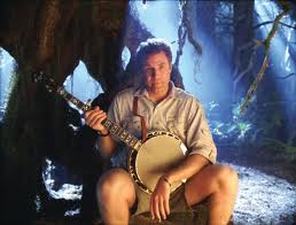
Will Ferrell in "Land of the Lost."
Even the suits are feeling the pain as a growing number of film and TV productions shift away from California.
Director Brad Silberling recalls a recent poignant visit by Universal chairman Marc Schmuger to the set of his upcoming comedy "Land of the Lost."
"He was just shaking his head," Silberling says. "He said, 'This is the only feature this studio has shooting on the lot.'"
Click here to read the entire article from The Hollywood Reporter.
Director Brad Silberling recalls a recent poignant visit by Universal chairman Marc Schmuger to the set of his upcoming comedy "Land of the Lost."
"He was just shaking his head," Silberling says. "He said, 'This is the only feature this studio has shooting on the lot.'"
Click here to read the entire article from The Hollywood Reporter.
To find out more about how far producers will to go to get a bargain, check out some of my other location reports : Malta 2023, Cherokee Nation 2022, New Mexico 2022, Upstate New York 2022, Kentucky 2022, New Mexico 2015, Louisiana 2015, Hawaii 2014, New Mexico 2014, Hawaii 2013, Fiji 2013, Pennsylvania 2013, Shooting Steven Spielberg's "Lincoln" in Virginia, Puerto Rico 2012, Northern California 2012, Massachusetts 2012, New Mexico 2012, Scout and About: Florida, U.S. Update 2011, Location Managers Plan World Shoots, Puerto Rico, Dominican Republic, Scout and About: Canada, Relativity Media Puts Muscle Behind Incentive Legislation, Scout and About: Georgia, Made in Utah, Made in Colorado, Made in Hawaii 2009, Made in Hawaii 2010, Hawaii Sizzles with Location Shoots, Made in Oregon, Made in Alaska, Made in Florida, Made in North Carolina, Made in Louisiana 2008, Made in Louisiana 2010, New Orleans: Bracing for the Next Storm, Made in San Diego, Locations 2003 and Locations 2010.
